Header
Hauptnavigation

Mariia Kudin
Beyond Care
Designing for Organisational Resilience and Children's Autonomy in Residential Care
Exploring the Problem
Around 30 young people live at Home of Joy, a residential care home (a children’s home where young people live full-time, often from early childhood until their mid-twenties) in rural Uganda, run by LFFC (Light for Forgotten Children Foundation, a Swiss NGO, or non-profit organisation working independently from government). Many arrived as small children and stay until their mid-twenties.
The home provides shelter, food, clothing, and access to education. There is no formal plan for what happens when someone leaves. Everyday skills like finding housing, making a doctor’s appointment, managing money, or resolving a conflict are rarely practised before the moment of departure.
Finding the Space In Between
The organisation knew the gap existed. What was missing was anything between full provision and the moment of leaving: no gradual handover, no regular space for children to practise making decisions, no connection to people who had already gone through it.
As the founder put it, young people who grow up with everything provided often have no framework for what self-sufficiency involves. The system produces this outcome.
How Does This Project Address the Issue?
I conducted interviews with practitioners in Uganda and Ukraine, mapped the people involved in each child’s life, and examined what actually happens compared to what the written policies say. From this I developed seven design criteria covering programme design, trust-based relationships, children’s participation, and organisational resilience (the ability of an organisation to keep functioning when staff leave or funding changes).
Two strategies came out of this work. The first focuses on resilience: each process gets a minimal version, defined in advance, so it can continue under reduced conditions and restart easily if interrupted. The second gives children a more active role while they are still in care.
How Does it Work?
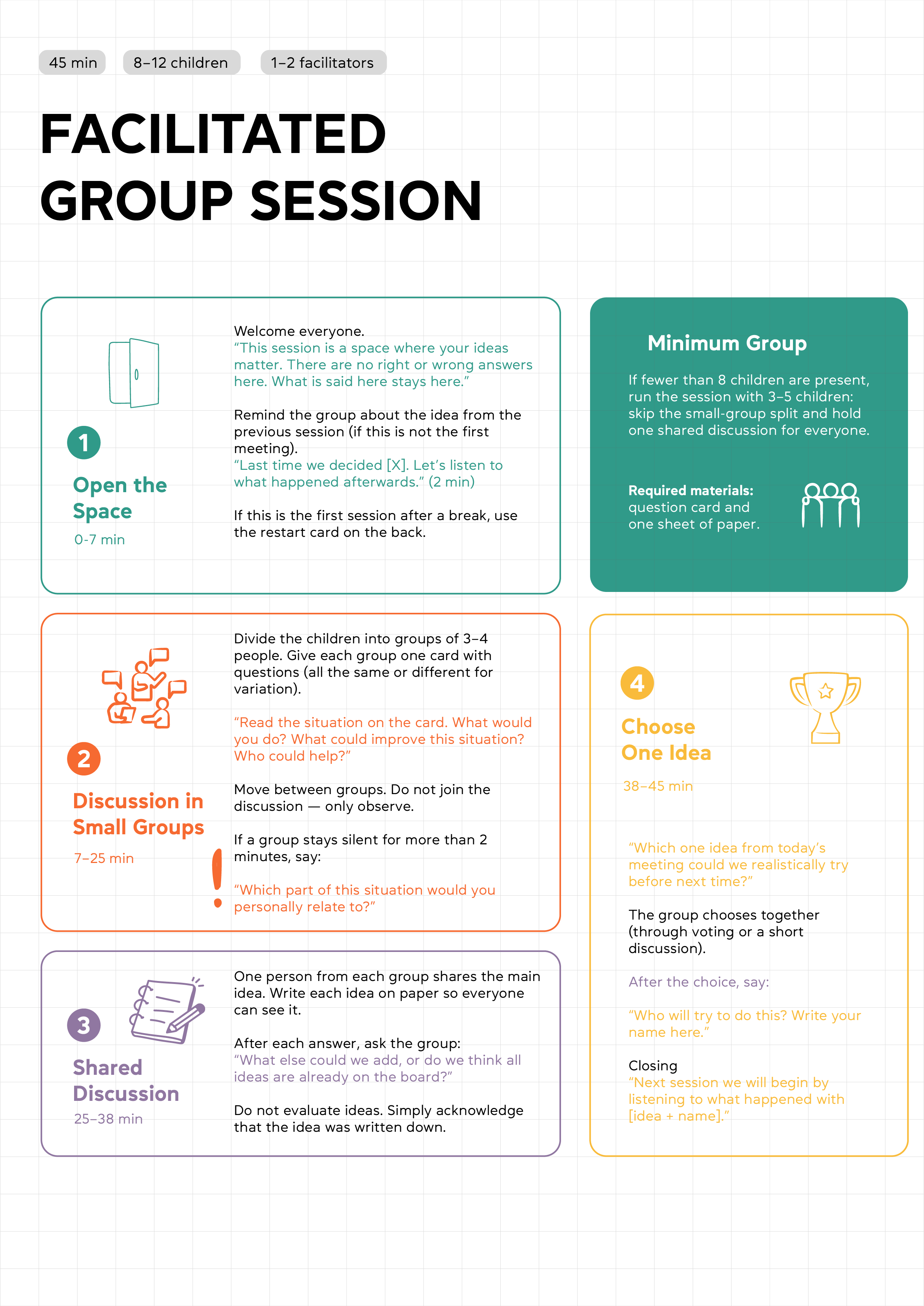
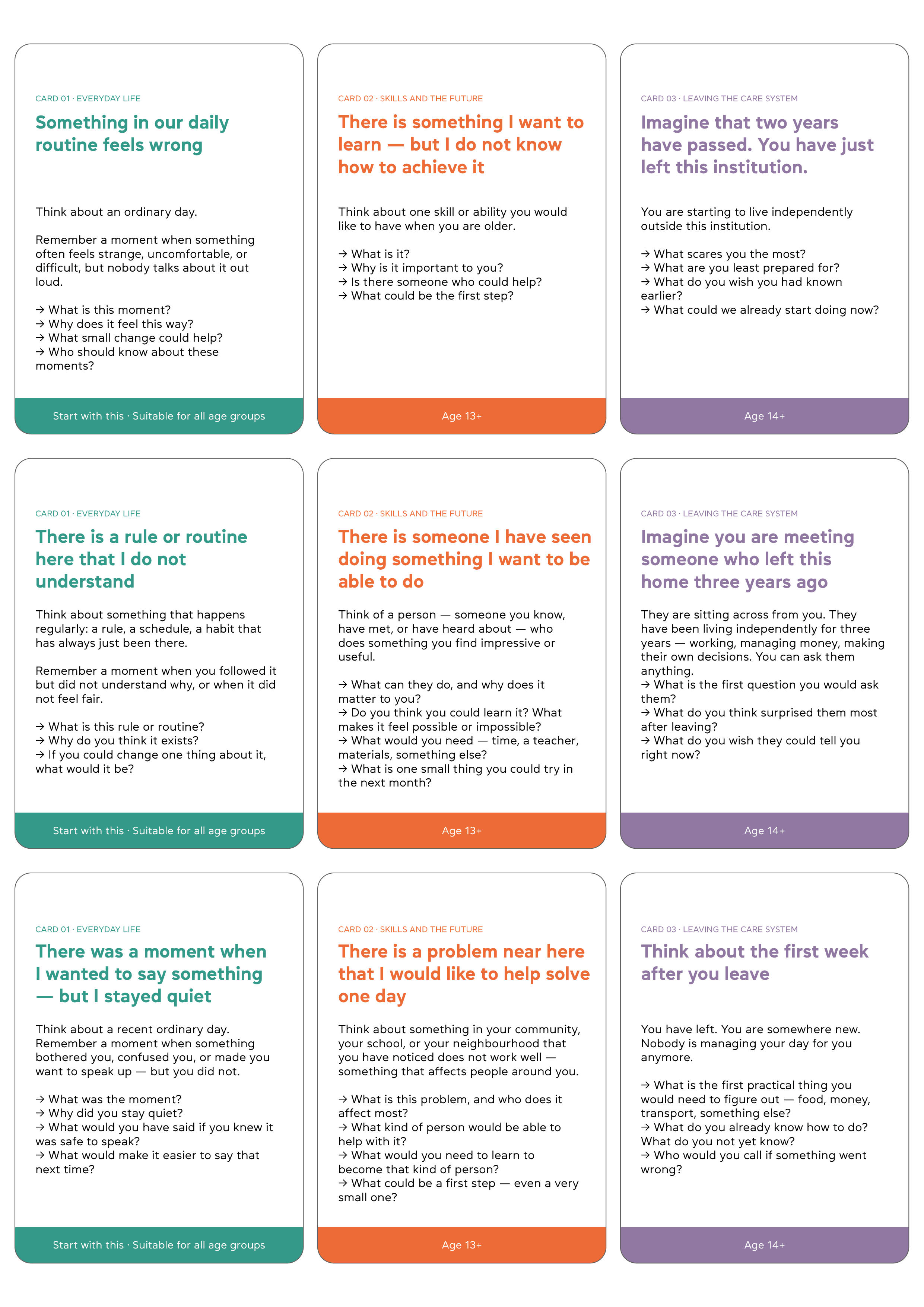
The second strategy introduces two practices. The first is a regular facilitated group session where children generate ideas together, starting with small familiar topics and gradually moving toward questions about their own lives. The second is an alumni encounter programme, where former residents return to speak with current children about what life after leaving actually looked like.
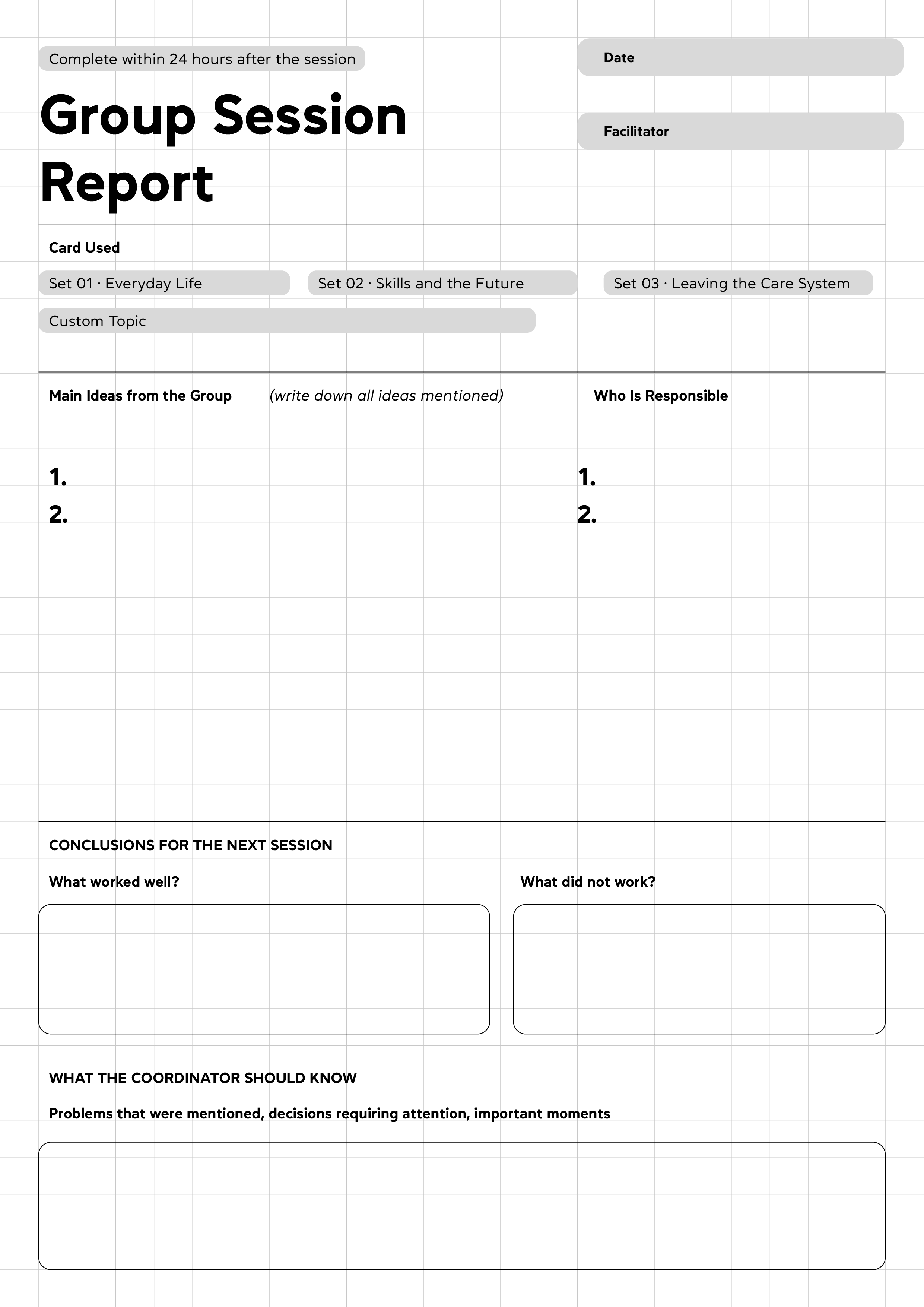
The prototype is a one-page printed facilitation guide for a 45-minute session. No technology is required. A local adult runs it using prompt cards and paper. If a session is skipped, the guide includes a way to restart from where things left off.
Why Does it Matter?
Children in residential care can be well looked after and still poorly prepared for what comes next. Small, consistent practices built into the organisation’s existing rhythm can shift this over time without new funding or outside coordination. Former residents already hold the most relevant knowledge. The alumni programme simply gives them a way to pass it on.

0 Kommentare