AI in Insurance: Time to Stop and Think!
As AI is poised at the threshold of the next wave of implementation, insurers and banks should reflect on their experience to anchor AI more effectively in operational and governance processes, and safeguard core expertise.

How Swiss insurers and banks can prepare to ride the next wave of artificial intelligence
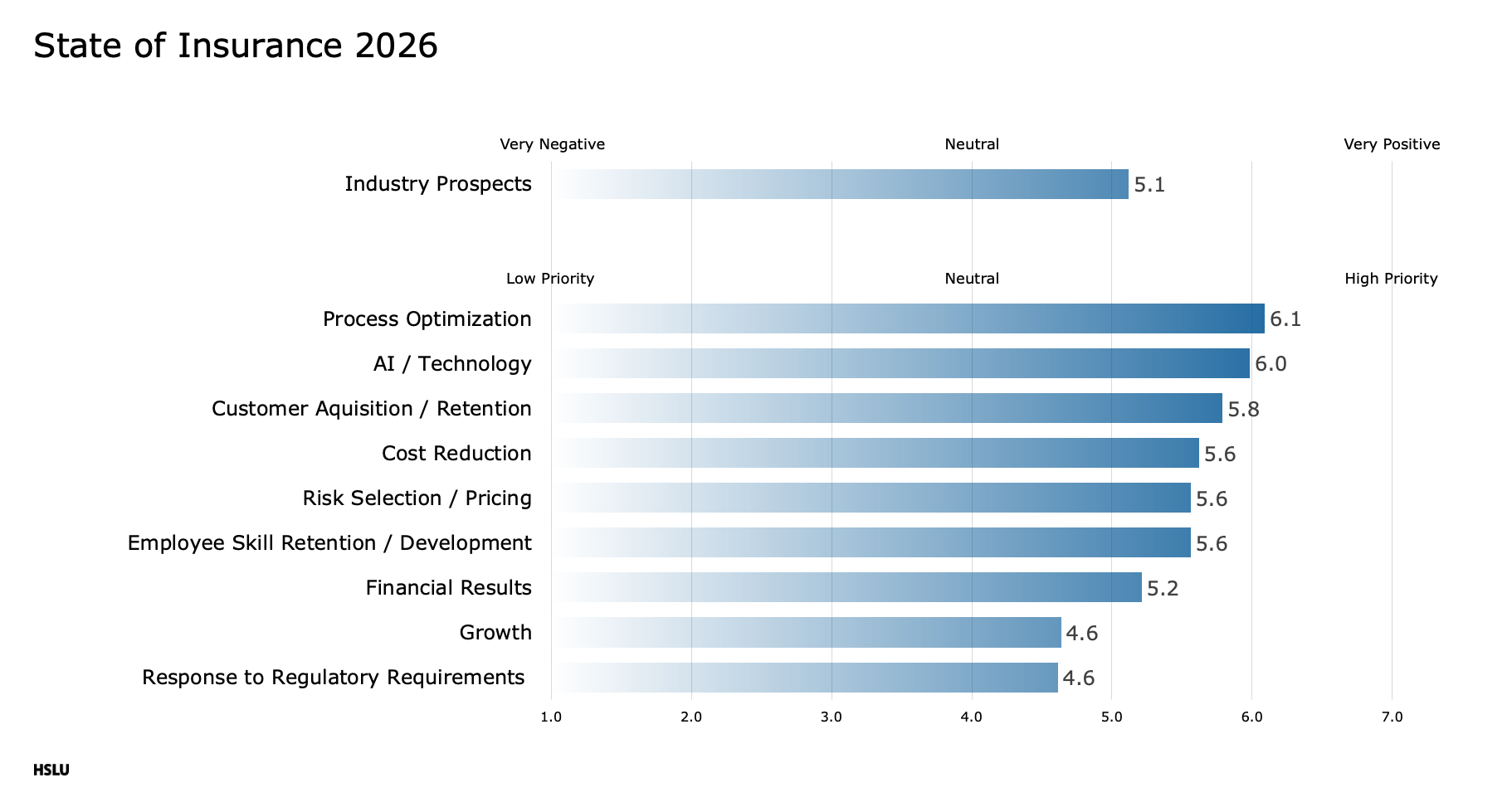
Artificial Intelligence (AI) is at the threshold for the next wave, with new fully autonomous and adaptive systems poised for implementation in the next few months. The challenges posed by these systems, however, are significant. It is not clear insurers and banks have addressed all the issues presented by these changes. At IFZ, together with our partner Parva consulting, we recently published a study to understand status, major challenges and suggestions for improvements for AI implementation in insurance and banking. The study combines the results of two technology-focused surveys among insurance and banking executives with 11 expert interviews. The message: pause to stop and think before continuing in this exciting journey!
Please click here for the complete study (in German):
https://drive.switch.ch/index.php/s/npha9PVEvT5Rzui

Four main points can be used to summarize the surveys and interviews regarding the current status:
Current focus of AI is on efficiency gains, and the potential has not yet been fully captured.
The communication regarding current efforts is uneven Sometimes companies report at length about proof-of-concept efforts and sometimes underreport production efforts. Most projects are focused on efficiency improvements in support processes, and with human-in-the-loop solutions. These minimize compliance and reputational risks, but limit the potential improvements. While the long-term impact of the current efforts is unclear, most experts interviewed believe there is still potential to be harvested from existing technologies.
Next steps in insurance will focus on the transformation of the core business. Know-how will be key.
In the next phase, AI projects will increasingly focus on core business processes. Here hallucinations and errors will not be accepted by regulators or by customers. Of course current processes are not perfect, but human agents can dynamically correct and satisfy customer requirements. In the future, this correction needs to be built into a human-AI hybrid process, where humans can interpret and correct AI actions and decisions. Thus, both technical and core business skills are required for an organization to thrive. Service providers can play an important role for technology deployment, but not as much for governance of AI processes. Insurers need to develop the governance internally.
Anchoring of AI in the organization will drive success.
The speed and success of AI deployment will not be decided by the technology. They will be decided by the effective integration of AI in the culture, governance, and business model of each organization. An important factor will be the knowledge and comfort of senior executives with AI. This will especially be the case when they will be required to support initiatives with clear potential but unclear business cases. AI will also need to be incorporated in the governance, just like any human process and responsibility is. This will need to start with a clear responsibility for data quality, decisions and outcomes.
At first an evolutionary phase. And then?
The new technologies offer multiple options. These , however, are combined with the need for investment, know-how, change management and evolving customer expectations. This combination practically guarantees the next changes for insurance companies with be evolutionary. The result will be the creation of a patchwork of solutions unique to each insurer. An open question at this point, and one where our experts remain divided, is whether this dynamic will continue in the long term. Alternatively, we could reach a tipping point, where key providers will be able to combine processes across multiple disciplines and deliver integrated solutions to insurers and banks.
What can insurers and banks do today?
To fully exploit the potential of AI in the current environment and prepare for the next phase of adaptive and autonomous AI solutions, our experts propose 3 main areas:
Develop executive and employee know-how, both in AI and in insurance.
Executives will need to be proficient both in their core business and in the technology in order to prioritize efforts and support deployment. The current informational activities are likely to prove insufficient, and real hands-on involvement is required to gain a deeper understanding of AI technologies. A similar point applies for the employees, who will be required to integrate in hybrid processes. A critical component is the identification of core business skills required in the company and the strategic coordination of activities to retain, develop, and protect these skills. Experts in the core insurance business will need to continue to be developed and care must be placed that these skills remain in the organization. A migration of these skills to service providers or AI systems will undermine a source of strategic advantage.
Adapt organizational structure and governance to AI.
The evolution of core business processes will require the evolution and alignment of organizational structures and governance. Unfortunately, it is not possible at this point to state clearly what the final form of this evolution will be. Thus, structure and governance will need to continue to evolve over time and will not just occur in one project. Critical in these times will be the definition of clear core principles, for example for governance, while retaining flexibility in the implementation. Critical and ethical thinking at multiple levels in the organization will the critical for a successful transformation.
Continue to explore, cooperate with others, invest in data infrastructure.
Much like riding a bicycle, integrating AI in insurance is a skill learned by doing. Thus, organizations will need to continue to explore different projects and ideas. While some or even most of them will turn to be less impressive than originally thought, organizations will learn through these efforts. They will therefore be ready to quickly implement transformational efforts as they emerge. In this context, interacting with players inside and outside the industry will provide for a healthy exchange. This exchange of ideas and experiences will include best practices, but also failed efforts. A clean, well-structured environment for data is key to both conceive and deploy new solutions. Investment in this infrastructure will need to proceed apace, even in the absence of detailed business cases.
Kommentare
0 Kommentare
Danke für Ihren Kommentar, wir prüfen dies gerne.